This report examines the rapid growth of the Australian export oaten hay industry, driven by strong global demand, particularly from key markets such as Japan, Korea, Taiwan and China. High profitability, improved genetics and advances in crop quality have contributed to the crop’s rising importance.
To sustain this growth, the industry must adopt emerging technologies that enhance breeding efficiency and deliver improved varieties.
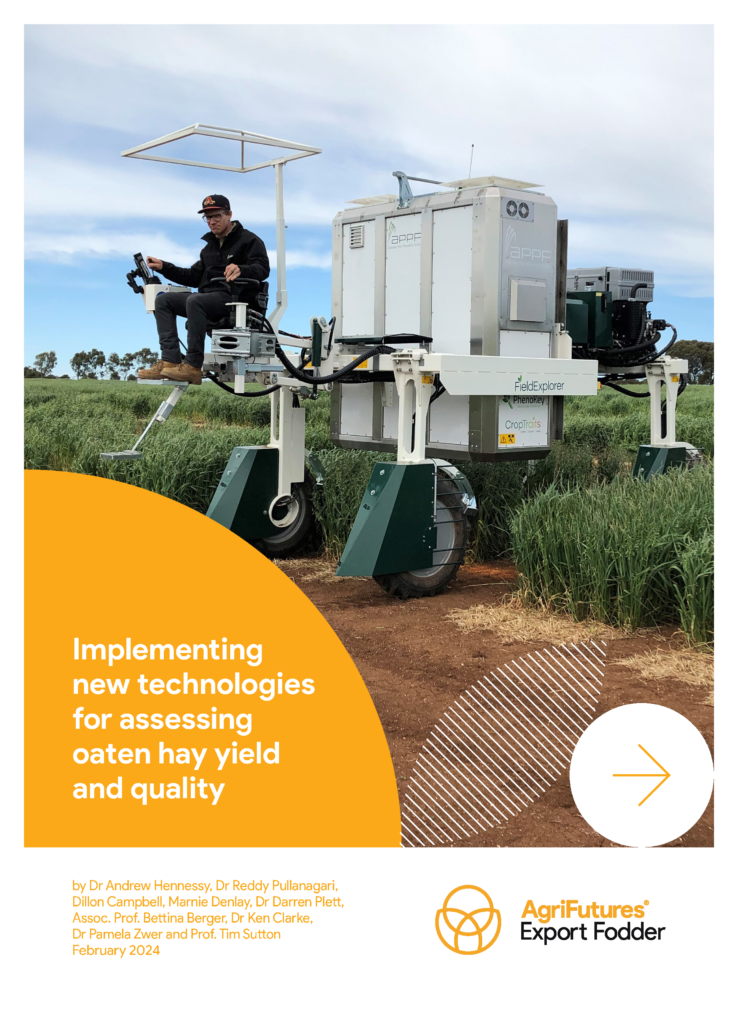
The research evaluates the use of advanced field-based and airborne sensing technologies to measure biomass and key hay quality traits. Data collected across South Australian field seasons from 2020 to 2022 utilised LiDAR and hyperspectral sensors mounted on both the FieldExplorer ground platform and unmanned aerial vehicles. The FieldExplorer integrates multiple sensors, including RGB imaging, hyperspectral cameras and LiDAR, enabling rapid and precise field phenotyping.
Results demonstrated moderate correlations between LiDAR data and biomass, with opportunities for improvement through higher-resolution data. Hyperspectral analysis using partial least squares regression delivered strong predictive accuracy for most quality traits.
The findings highlight the potential of sensor technologies to support breeding programs and improve productivity, quality and competitiveness across Australia’s oaten hay industry.
Read the project snapshot here.