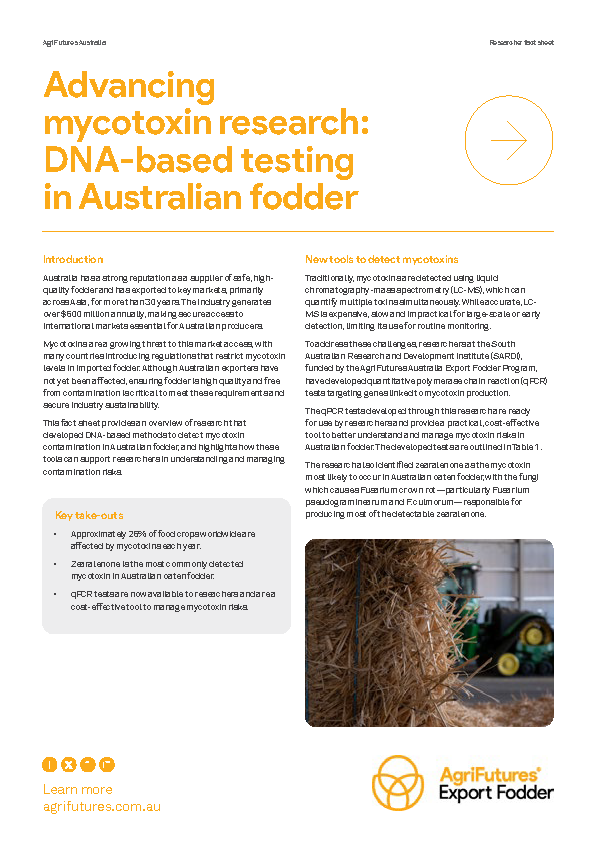
Australia’s export fodder industry depends on high quality and strong market access. However, mycotoxins are a growing risk as global regulations tighten. This research responds to that challenge by developing faster detection tools.
Traditionally, LC-MS methods are accurate but slow and expensive. In contrast, new DNA-based qPCR tests offer a quicker and more cost-effective option meaning researchers can detect mycotoxin risks earlier.
The study, led by SARDI and funded by AgriFutures Australia, identified zearalenone as the main mycotoxin in oaten fodder. Importantly, it is linked to Fusarium species.
These tools support better risk management, help protect fodder quality and maintain access to export markets.
RELATED: Fact sheet: Managing mycotoxin risk in export fodder