
Report: The impact of climate on sorghum utilisation in poultry diets
Climate change feed grains research examines wheat, barley, maize and sorghum for poultry diets and practical ways to protect quality and supply.
 CHICKEN MEAT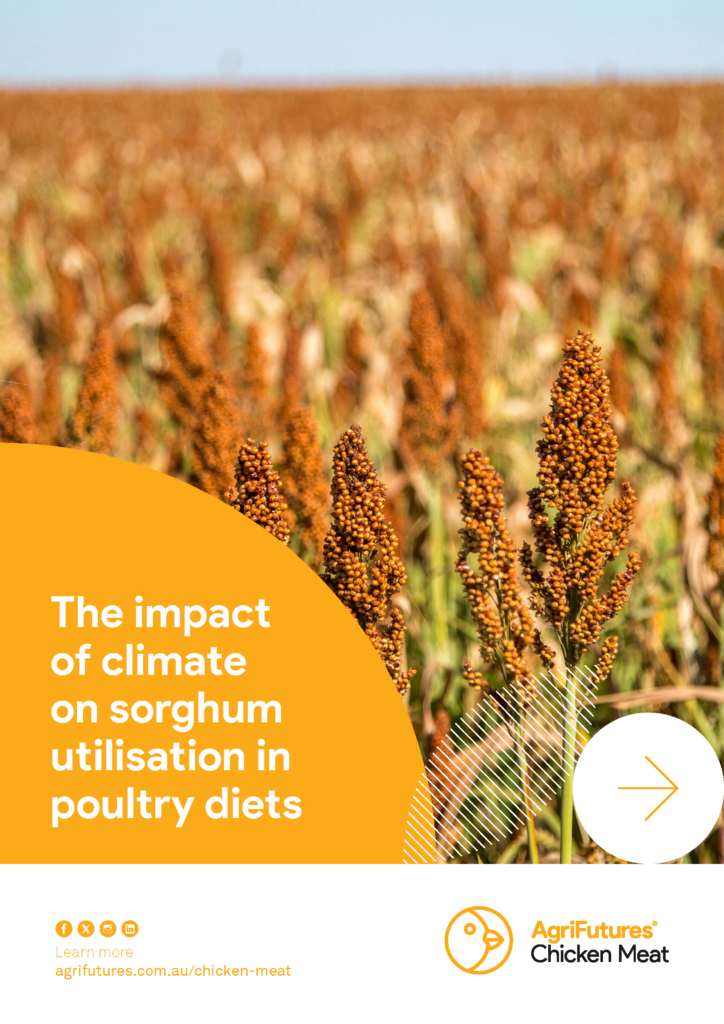
86 pages
Published: 2 Jun 2026
Publication Code: PRJ-012265
Author(s): Macelline, S., Toghyani, M. , Kim, E. , Liu, S.
ISBN: 978-1-76053-635-0



Download report PDF
DownloadPurchase a hard copy - AUD $55
This report looks at how climate change affects feed grains used in poultry production. It focuses on wheat, barley, maize and sorghum.
The review explains how higher carbon dioxide, heat and drought work together to change grain yield and grain quality. It compares C3 grains, wheat and barley, with C4 grains, maize and sorghum.
Results show that extra carbon dioxide can increase starch and lift yield in wheat and barley. However, it can also lower protein, fat, vitamins and minerals. Heat and drought then reduce these gains.
Maize and sorghum gain little from extra carbon dioxide, but both still suffer under heat and water stress. The report also presents feeding studies with broiler chickens. These studies compare transgenic and commercial sorghums, dryland and irrigated sorghums, grain varieties and grain density, and additives for red sorghum diets.
Higher-protein transgenic sorghums reduced soybean meal use without harming feed conversion. Sodium metabisulfite also improved the value of red sorghum diets.
Overall, the report offers practical ways to manage climate risk in feed grains. It highlights options in crop breeding, grain processing, enzyme use and farm management to support more reliable poultry production in Australia. It also points to stronger feed supply under future climates.
Climate change feed grains research examines wheat, barley, maize and sorghum for poultry diets and practical ways to protect quality and supply.
This research examines how climate stress and feed innovations affect grain quality and broiler performance. It highlights how CO2, heat and drought shape wheat, barley,...
This report examines the use of lactic acid bacteria as a natural bioprotective approach to reduce Campylobacter on raw chicken meat. Screening over 1,100 isolates,...
Explore chicken meat emission pathways to 2050, with costs, feasibility and offsets across net zero, SBTi and floating targets.
The principal aim of these guidelines is to ensure that the chicken meat industry’s ongoing economic growth upholds the principles of environmentally sustainable and socially...
The principal aim of these guidelines is to ensure that the chicken meat industry’s ongoing economic growth upholds the principles of environmentally sustainable and socially...
The findings of the Economic contribution of Australia’s chicken meat industry report highlight the importance of the chicken meat industry in Australia’s agricultural landscape
The findings of the Economic contribution of Australia’s chicken meat industry report highlight the importance of the chicken meat industry in Australia’s agricultural landscape.