


Fast turnaround for Hendra diagnosis improves horse welfare and human safety

Share

  • Share on LinkedIn
  • Share via Email
  • Share Link
  • Print
Three people stand in a rural horse stable in Australia with a brown horse. One holds a medical device, another the horse’s reins, and the third person has a packet. All are smiling and dressed in casual or medical attire, reflecting their agricultural setting.

Veterinarians at The University of Queensland are now able to diagnose the deadly Hendra virus in horses in under an hour with a new rapid diagnostic point-of-care test. The new test rapidly detects the pathogen on site reducing the exposure to both humans and other horses.

Hendra virus is highly infectious and lethal. Spread to horses from flying foxes, infected horses can pass the virus from horse to horse, as well as to humans.

Lead researcher Professor Ben Ahern, from The University of Queensland, said a rapid point-of-care diagnostic test to detect Hendra infections in horses has been sorely needed for decades.

“Without vaccination, the virus has a case fatality rate of 57% among humans and 79% among horses. It’s incredibly deadly.”

“Rather than sending samples off to a lab, which risks an outbreak in the meantime, our testing protocol takes routine samples from a possibly infected horse and inactivates any virus that may be present in those samples.”

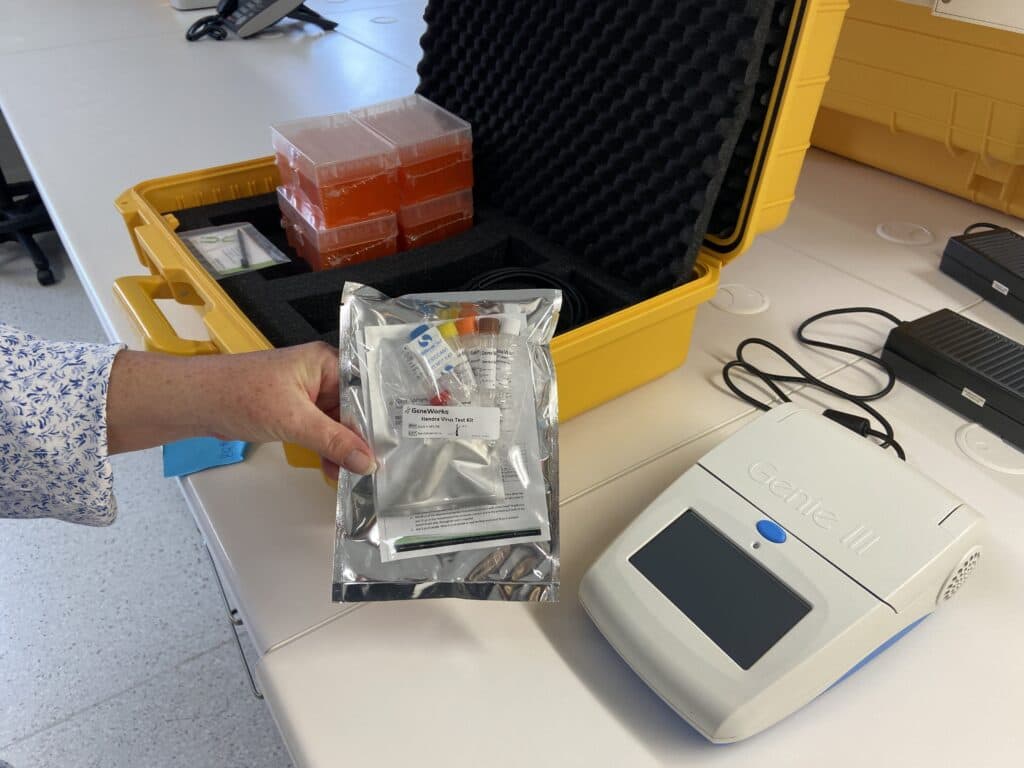
“Following a heat treatment step of samples to inactivate the virus, these non-infectious samples are then tested using a handy molecular diagnostics machine – known as a LAMP Genie III – which is about the size of a box of tissues and is battery powered and completely portable.”

“This process gives us results in under one hour, which is incredibly fast when compared to the many days it may take from collection of samples, getting them tested at an external lab and obtaining results.”

“Horses aren’t suffering in the interim and humans giving care to them can avoid becoming exposed.”

Development of the POC Hendra Virus LMAP test has advanced to the manufacturing stage and commercial kits are being produced.

Pending final approval from the Queensland Chief Veterinary Officer, the Genie machine and Hendra Virus LAMP kits will be available for veterinarians to purchase and use.

The cost and technical training required means the tests will most likely need to be performed by veterinarians, but the mobile capacity of the testing system means veterinarians can go directly to a farm for a diagnosis and treatment of horses.
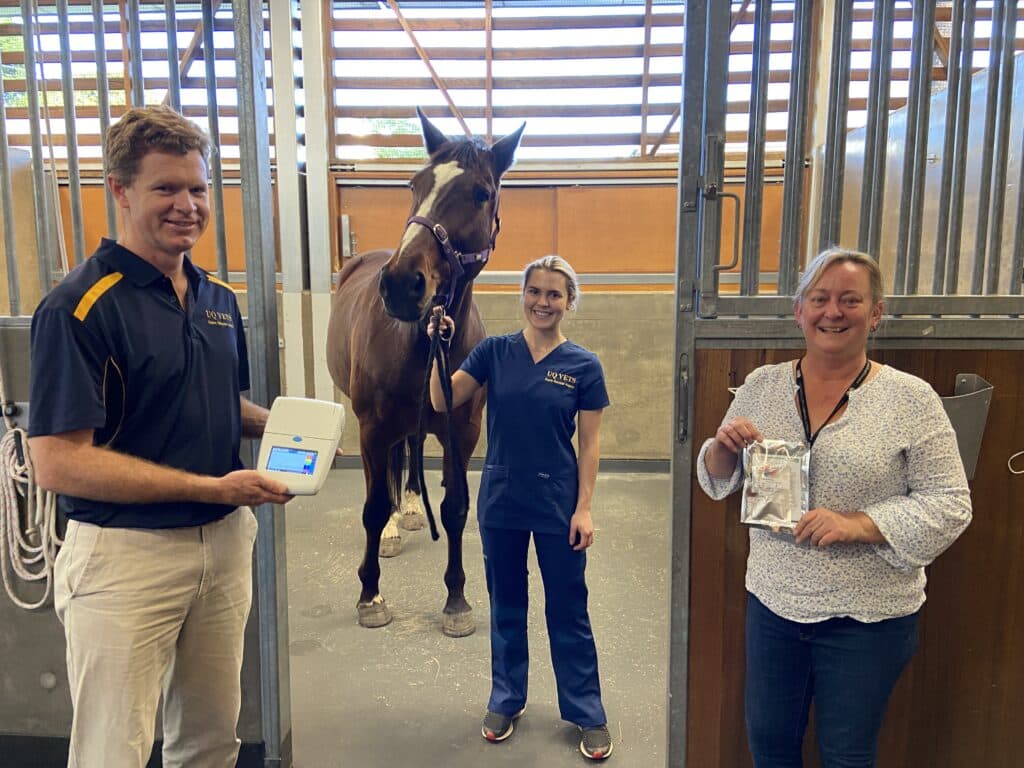
Three people stand in a rural horse stable in Australia with a brown horse. One holds a medical device, another the horse’s reins, and the third person has a packet. All are smiling and dressed in casual or medical attire, reflecting their agricultural setting.

A hand holds a sealed lab kit next to a Genie III machine on a table, highlighting research essentials with a yellow case of lab equipment and red sample containers in the background—key tools for advancing agriculture.

Annelies McGaw, AgriFutures Australian Manager Research said, “The project is a big win for horse and human health.”

“The AgriFutures Thoroughbred Horses Program invests in research and development that improves the profitability and sustainability of the Australian thoroughbred industry, meaning the health of our farmers, stablehands, farriers and horses is critical.”

“This research has resulted in timely and tangible solutions for the thousands of people working in horse-related industries across Australia and we are thrilled to see these tests becoming a reality.”

Bruce Farrar, Chief Executive Officer Equestrian NSW, and project partner said, “We look forward to the rollout of the testing kits to provide a safer and faster diagnosis of suspected Hendra virus cases.”

The research will maximise horse welfare and human safety allowing appropriate treatment of horses to occur more quickly, reduced exposure to those caring for horses with suspected Hendra infections, and a reduction in the case mishandling errors due to delays in diagnosis.

The project, funded by AgriFutures Thoroughbred Horses Program, brings together the equine sector with co-investment from Equestrian NSW, the Department of Agriculture and Fisheries Queensland’s Biosecurity Sciences Laboratory, Geneworks, Equine Veterinarians Australia, the Australian Veterinary Association and five private Queensland and New South Wales veterinary practices. The project is led by Associate Professor Ben Ahern, The University of Queensland.

This was first published by The University of Queensland as No horsing around: super-fast Hendra test developed.

Latest News

  • EXPORT FODDER / 02.06.26

    AgriFutures welcomes two new members to Export Fodder Advisory Panel

  • 02.06.26

    Early bird tickets now on sale for the 2026 AgriFutures Rural Women’s Award Gala Dinner & National Announcement

  • HONEY BEE & POLLINATION / 26.05.26

    Help shape the future of Australian beekeeping: Advisory Panel recruitment open

  • THOROUGHBRED HORSES / 20.05.26

    More than a miss: Scientists identify a gene variant that causes early pregnancy loss