
AgriFutures Rice Program RD&E Plan 2027-32
Australian Rice Industry RD&E Plan 2027-2032 outlines priorities for productivity, water-efficiency and resilience. Read the full report.
 RICE
RICE 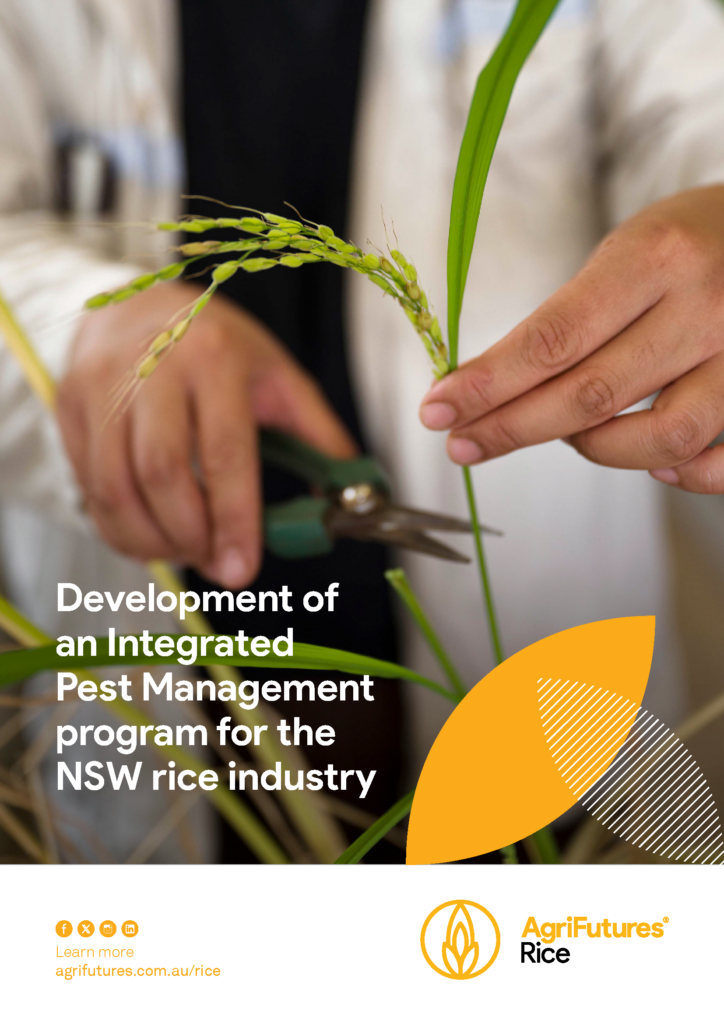
74 pages
Published: 6 Jul 2026
Publication Code: 26-060
Author(s): Hoskins, J.
ISBN: 978-1-76053-637-4



Download report PDF
DownloadPurchase a hard copy - AUD $45
This report examines new ways to manage pests in NSW rice crops. It supports growers in reducing their reliance on broad-spectrum insecticides while maintaining crop productivity. The research focused on major invertebrate pests in the Riverina, including native armyworms, rice bloodworms and rice snails. It also investigated whether Russian wheat aphid poses a risk to rice production.
The project produced valuable information to strengthen integrated pest management (IPM) in the rice industry. Researchers identified key natural enemies that help control armyworm populations. They also improved understanding of how pest numbers affect crop losses and developed more reliable treatment thresholds. These findings help growers make better pest management decisions.
The study generated data to support the registration and use of selective insecticides. These products can control pests while reducing impacts on beneficial insects and lowering the risk of pesticide resistance. Researchers also identified resistance to existing bloodworm treatments and assessed alternative control options.
The project confirmed that rice is not a suitable host for Russian wheat aphid. This finding removes uncertainty for growers and helps avoid unnecessary pesticide use.
Overall, the report shows that successful pest management depends on combining biological control, selective pesticides, resistance management and ongoing research. These approaches can improve sustainability, protect crop yields and support the future of rice production in NSW.
Read the project snapshot here.
Australian Rice Industry RD&E Plan 2027-2032 outlines priorities for productivity, water-efficiency and resilience. Read the full report.
Australian Rice Industry RD&E Plan 2027-2032 outlines priorities for productivity, water-efficiency and resilience. Read the summary.
This project investigated whether beneficial arbuscular mycorrhizal fungi could improve water and nutrient use in aerobic rice systems. Results showed improved water-use efficiency and phosphorus...
This report strengthens integrated pest management for the NSW rice industry by improving understanding of key pests, natural enemies and resistance risks. The findings support...
This report strengthens integrated pest management for the NSW rice industry by improving understanding of key pests, natural enemies and resistance risks. The findings support...
Real-time remote sensing enables Australian rice growers to monitor paddocks using satellite data, weather and machine learning. The system delivers accurate predictions on crop growth,...
This project delivered real-time rice crop monitoring tools using satellite imagery and weather-driven models to support Australian rice growers. Grounded in decades of agronomy research,...
The Rice Breeding Australia 2025 Annual Report highlights a year of significant progress in transforming Australia’s rice breeding program.