
AgriFutures Rice Program RD&E Plan 2027-32
Australian Rice Industry RD&E Plan 2027-2032 outlines priorities for productivity, water-efficiency and resilience. Read the full report.
 RICE
RICE 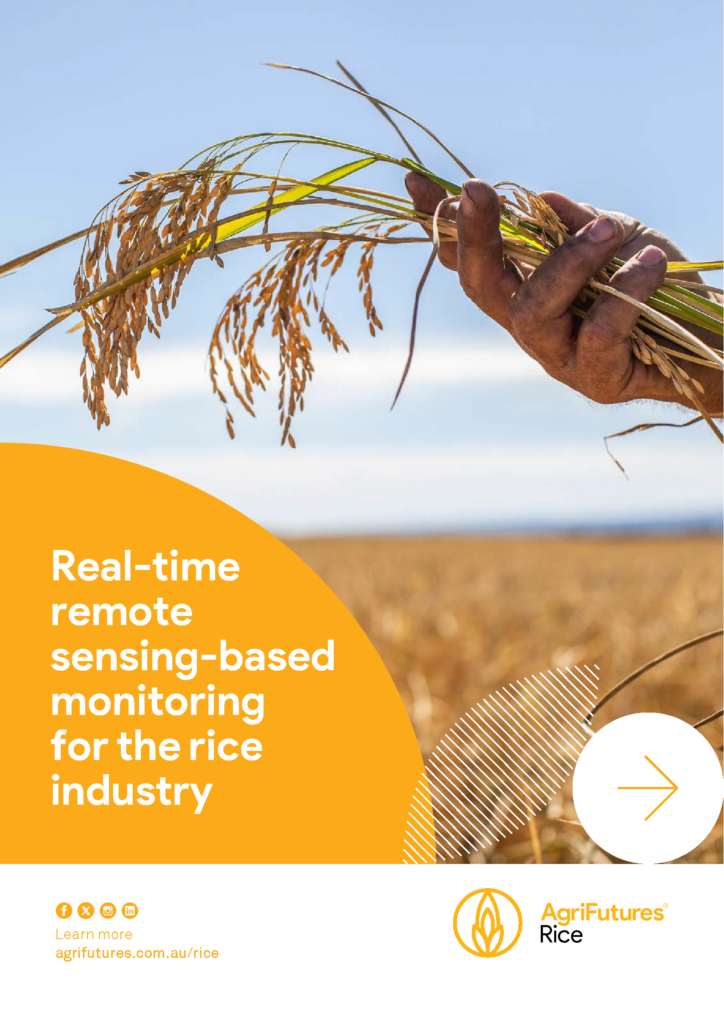
73 pages
Published: 19 May 2026
Publication Code: PRO-013078
Author(s): Brinkhoff, J., McGavin, S., Jha, S., Groat, M.
ISBN: 978-1-76053-627-5



Download report PDF
DownloadPurchase a hard copy - AUD $45
The Australian rice industry is a world leader in land and water productivity and has low emissions intensity. However, it faces growing pressure from variable water supply, changing weather and the need to measure and reduce emissions. In addition, growers must compete with the returns from other crops.
As a result, the AgriFutures Rice Program strategic plan (2021-2026) set a clear water productivity target of 1.5 tonnes per megalitre. Achieving this target requires progress across agronomy, breeding, technology use and farming systems. This project directly responded by developing practical decision-support tools for real-time rice crop monitoring.
The tools use satellite imagery and weather-based models and are built on decades of Australian rice research. Importantly, they draw on proven knowledge of water and nitrogen management, variety performance, crop growth stages and yield drivers. Using this foundation, the project trained accurate machine learning models with data collected over four rice seasons from 2022 to 2025.
Data came from commercial fields, NSW DPIRD trials, Sentinel‑2 satellites and SunRice production records. Together, these sources supported reliable paddock-level predictions of crop growth, nitrogen uptake, grain moisture and yield.
Read the project snapshot here.
Finally, the insights were delivered through daily online dashboards for growers and agronomists. Consequently, users made better and more timely decisions, improving productivity and efficiency. With more than 85% adoption in the Riverina, the tools also support industry planning, emissions reporting and long-term sustainability.
Australian Rice Industry RD&E Plan 2027-2032 outlines priorities for productivity, water-efficiency and resilience. Read the full report.
Australian Rice Industry RD&E Plan 2027-2032 outlines priorities for productivity, water-efficiency and resilience. Read the summary.
This project investigated whether beneficial arbuscular mycorrhizal fungi could improve water and nutrient use in aerobic rice systems. Results showed improved water-use efficiency and phosphorus...
This report strengthens integrated pest management for the NSW rice industry by improving understanding of key pests, natural enemies and resistance risks. The findings support...
This report strengthens integrated pest management for the NSW rice industry by improving understanding of key pests, natural enemies and resistance risks. The findings support...
Real-time remote sensing enables Australian rice growers to monitor paddocks using satellite data, weather and machine learning. The system delivers accurate predictions on crop growth,...
This project delivered real-time rice crop monitoring tools using satellite imagery and weather-driven models to support Australian rice growers. Grounded in decades of agronomy research,...
The Rice Breeding Australia 2025 Annual Report highlights a year of significant progress in transforming Australia’s rice breeding program.