
Report: Thoroughbred Breeding Industry Workforce Strategy 2026
Explore the Thoroughbred Breeding Workforce Strategy and discover priorities to strengthen workforce capability, participation and productivity.
 THOROUGHBRED HORSES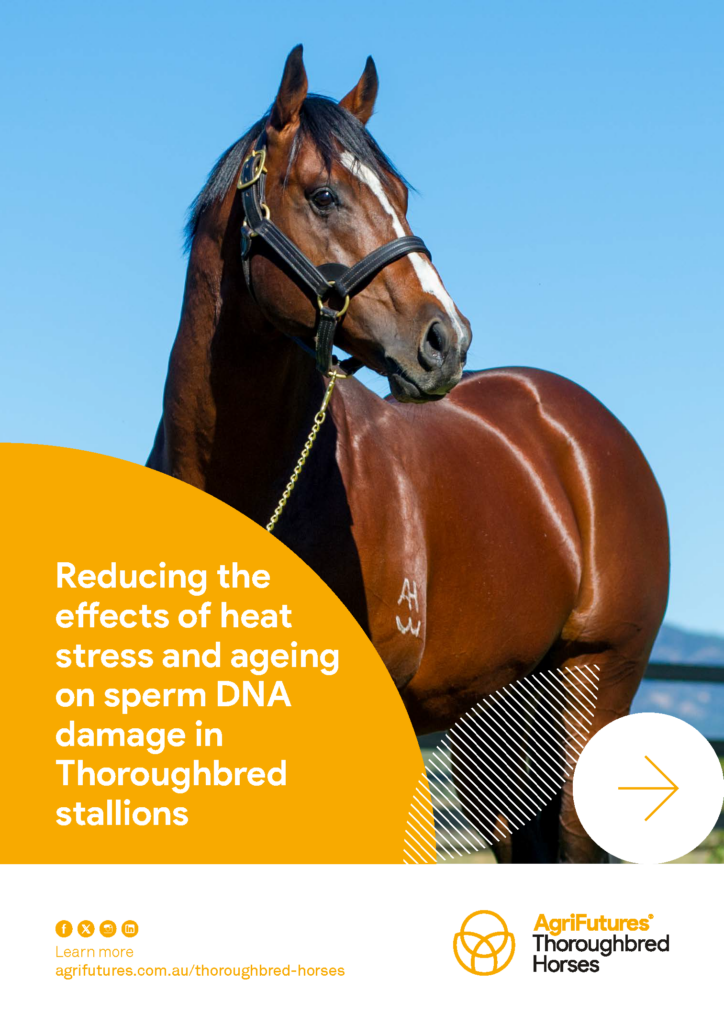
6 pages
Published: 9 Jul 2026
Publication Code: 26-061
Author(s): Gibb, Z.



Download report PDF
DownloadThoroughbred stallion fertility drives breeding success in Australia; however, conception rates remain modest and often fall with age and heat.
This project examined how oxidative stress damages sperm DNA and affects fertilisation, embryo growth and foal performance. To address this, researchers used lab tests, field monitoring and a controlled nutrition trial. They assessed semen quality, climate effects and long-term progeny outcomes.
Overall, results showed that oxidative stress is the main cause of sperm DNA damage. In particular, heat and ageing increased this stress and reduced fertility. Consequently, the study identified practical tools for industry use. The halo assay and sperm chromatin structure assay suit routine screening, while the comet assay detects finer damage in research.
About 20% of stallions showed high sensitivity to heat and clear fertility loss under high temperature–humidity index (THI) conditions. The team also developed a horse-specific THI to predict risk periods.
In addition, targeted nutrition improved outcomes. L-carnitine and NTFactor® Lipids strengthened sperm membranes and improved resistance to stress. As a result, studs can identify at-risk stallions earlier and manage heat impacts more effectively.
These tools can lift pregnancy rates, extend breeding careers and improve industry productivity.
Explore the Thoroughbred Breeding Workforce Strategy and discover priorities to strengthen workforce capability, participation and productivity.
Explore equine fetal membrane baseline research establishing normal pathology standards to improve reproductive diagnostics and foal outcomes.
Explore equine fetal membrane standards that improve diagnosis of pregnancy loss and support mare and foal health.
Stallion fertility oxidative stress drives sperm damage in thoroughbreds. Explore diagnostics, nutrition and heat tool to lift pregnancy rates.
This report examines peritoneal fluid isoprostanes as biomarkers for equine colic severity and surgical need. Findings highlight their potential to improve early diagnosis and decision-making,...
This report examines peritoneal fluid isoprostanes as biomarkers for equine colic severity and surgical need. Findings highlight their potential to improve early diagnosis and decision-making,...
This project examines variability in laryngeal function in Thoroughbred yearlings during pre-sale endoscopy. It assesses how timing, location and technique affect grading consistency. Findings will...
This report examines strangles, a highly contagious horse disease caused by Streptococcus equi. Researchers tested 923 horses across 36 Australian properties and found 15% had...