
Fact sheet: Weed management
Oat hay weed control fact sheet outlining identification, export standards and practical management options to prevent contamination and protect hay quality.
 EXPORT FODDER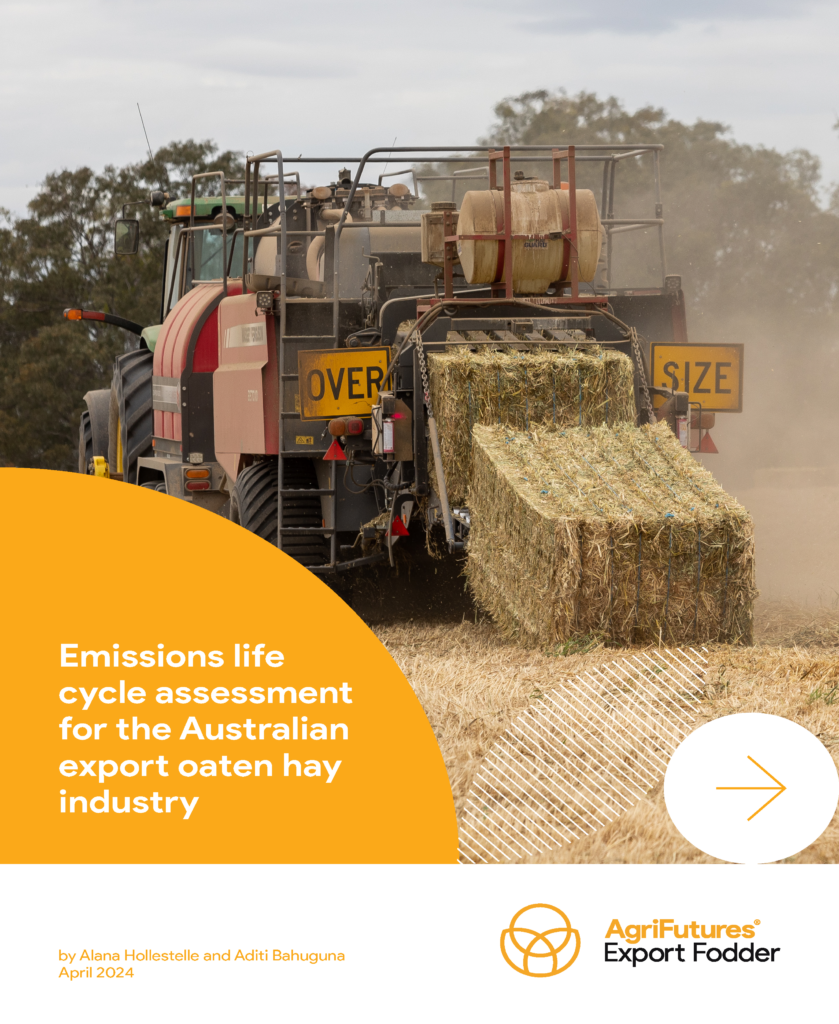
54 pages
Published: 30 Apr 2024
Author(s): Bahuguna, A., Hollestelle, A.
ISBN: 978-1-76053-503-2



Download report PDF
DownloadPurchase a hard copy - AUD $45
This report presents the first industry-level life cycle assessment (LCA) of greenhouse gas emissions across the Australian export oaten hay supply chain.
As global markets place greater emphasis on climate action, exporters face increasing pressure to measure and reduce emissions. In particular, major buyers such as Japan and South Korea are strengthening their emissions targets. At the same time, the European Union’s Carbon Border Adjustment Mechanism (CBAM) is increasing the focus on emissions in international trade.
The study establishes a baseline of emissions for the export oaten hay industry. It identifies the main sources of emissions across the supply chain. The assessment uses a broad system boundary. As a result, it captures emissions from raw material production, farm inputs, hay production, processing, domestic transport and maritime shipping.
To develop a reliable emissions inventory, the project combined extensive desktop research with consultation from industry experts. Furthermore, the findings were compared with available data from competing feed products produced in other regions.
Importantly, the report provides a foundation for future emissions-reduction initiatives. It also highlights opportunities to improve industry competitiveness in markets that value lower-emissions products. The findings will help Australian exporters respond to changing market expectations and strengthen the long-term position of Australian export oaten hay.
Oat hay weed control fact sheet outlining identification, export standards and practical management options to prevent contamination and protect hay quality.
This fact sheet explains how to store and transport hay to maintain quality and meet export standards. It outlines risks from moisture, sunlight and poor...
Oat crop diseases guide covering identification, risks and control methods to protect hay quality and meet export standards.
Manage oat crop pests to protect hay quality and meet export standards. Learn key pests, control methods and compliance requirements.
Oaten hay making guide covering cutting timing, curing and baling methods to maximise quality and yield. Learn how to improve outcomes.
Oaten hay market analysis explains demand, quality standards, and export requirements to maximise returns and reduce risk.
Australia’s export fodder industry relies on maintaining high quality and meeting strict international regulations, with mycotoxins posing a growing risk to market access. This research...
Zearalenone is the primary mycotoxin risk in Australian export fodder, driven by Fusarium species linked to cereal crown rot. Although exports are not yet widely...